VOStack open-source Software Stack for the virtualization of IoT devices

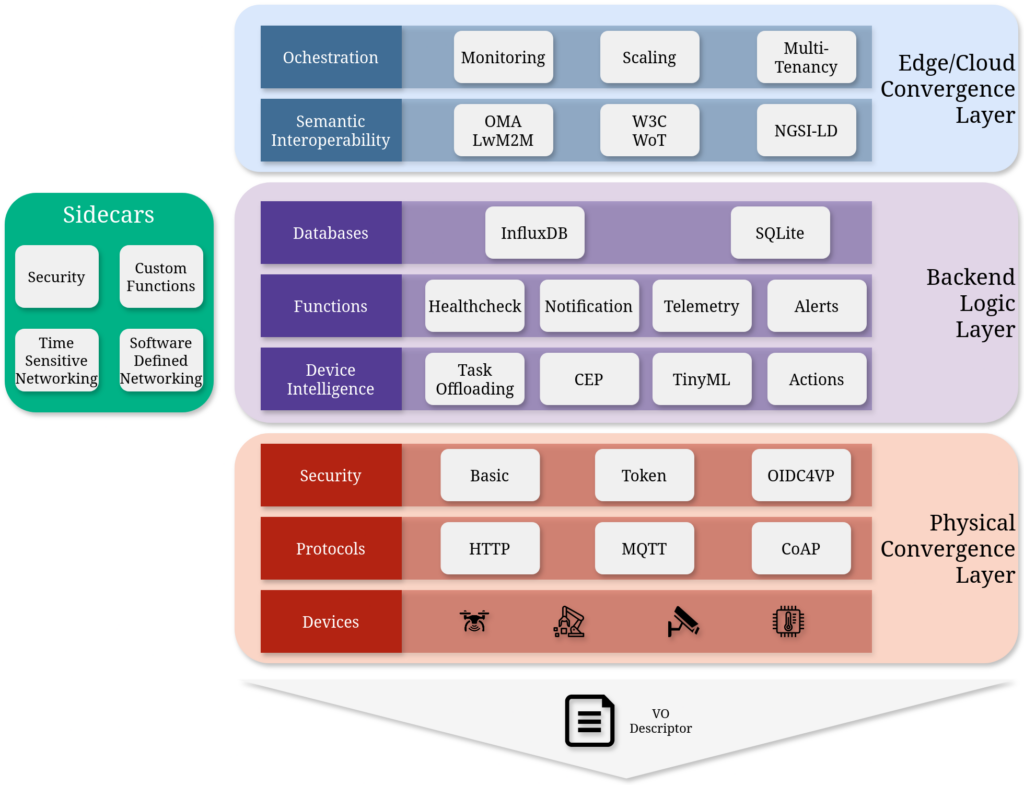
A Virtual Object (VO) is considered as a virtual counterpart of an IoT device. It provides abstractions for managing any type of IoT device while augmenting the supported functionalities through a multi-layer software stack, called as VOStack. The VOStack is an open-source software stack that supports interaction with both physical IoT devices and edge/cloud computing orchestration platforms. It has three main architectural layers namely: the Physical Convergence Layer, the Edge/Cloud Convergence Layer, and the Backend Logic Layer. The Physical Convergence Layer is responsible to tackle the major challenges of connecting the IoT devices with the computing continuum infrastructure. The Backend Logic Layer is responsible for augmenting the functionalities and capabilities of IoT devices. The Edge/Cloud Convergence Layer is responsible for bringing the VO closer to the application and orchestration layer. The implementation of VOStack is aligned with the specifications provided by the W3C Web of Things (WoT) Working Group. The VOStack is implemented in the framework of the NEPHELE Horizon Europe project.

GitLab repository: https://gitlab.eclipse.org/eclipse-research-labs/nephele-project/vo-wot Documentation: https://netmode.gitlab.io/vo-wot/

Synergetic Meta-Orchestrator for Distributed Applications

The Synergetic Meta-Orchestrator (SMO) supports the efficient deployment and orchestration of distributed application graphs over computing and network resources in the computing continuum. It takes deployment requests via the dashboard, formulates deployment plans based on infrastructure status and user-defined requirements, and continuously monitors the system to trigger optimizations when necessary. The SMO interacts with the multi-cluster resource manager and the network resource manager to ensure efficient resource utilization. The SMO is implemented in the framework of the NEPHELE Horizon Europe project.

GitLab repository: https://gitlab.eclipse.org/eclipse-research-labs/nephele-project/smo

FUSION

FUSION aims to design and implement an open-source observability and analytics framework that integrates diverse signals (i.e., metrics, traces, and logs). The framework supports efficient collection and analysis of heterogeneous data and exposes the results through open Application Programming Interfaces (APIs). By applying various analysis pipelines to the fused data, FUSION delivers advanced analytics, supports mitigation strategies, and enhances orchestration mechanisms. The developed framework leverages open-source tools (e.g., OpenTelemetry, Prometheus, Grafana, Elasticsearch) and is published under a permissive free software licence. It incorporates the foundational tasks of setting up data collection mechanisms to handle heterogeneous data from diverse sources in accordance with the OpenTelemetry standard, aggregating this data into a unified schema, and implementing APIs to facilitate seamless data integration. It includes prototype AI-based analytics functions and components such as anomaly detection, and root cause analysis. Future development will focus on building advanced reporting/visualization tools.

GitLab repository: https://gitlab.com/netmode/fusion
License: Creative Commons Attribution Share Alike 4.0 International

LORCA

LORCA is an open-source microservice-based streaming application that revolves around smart manufacturing, explicitly focusing on real-time surveillance of manufacturing processes and ensuring safety through prompt responses to detected anomalies. The use case involves a stationary robotic arm performing specific functions whose operation must be automated. Additionally, a remotely controlled robotic vehicle allows a user to monitor the location. This remote driving feature includes streaming a video feed from a camera mounted on top of the vehicle to the operator and transmitting remote control commands in the opposite direction. Another key aspect is the integration of machine learning-based object detection on frames sampled from the video feed. This functionality enables real-time data analysis and decision-making, triggering an alert to automatically pause the robotic arm when necessary.

The provided functionality consists of two separate workflows: one related to the remote operation (i.e., tele-operation) of the smaller vehicle and another regarding object detection and alert generation, which control the robotic arm’s operation. The main components of the remote operation workflow include a sender at the vehicle transmitting the native MJPEG video stream and an encoder at the edge that receives the video stream, encodes it to H264, and publishes it to the media server, which in turn distributes the newly encoded stream via WebRTC. Finally, the frontend at the remote operation center serves as the interface with the human operator, displaying the received video feed and accepting the remote-control input that is relayed to the vehicle. The object detection workflow consists of a sampler at the edge that receives the same video feed from the camera mounted on top of the vehicle, samples frames at a dynamically adjustable rate, and provides them as input to the object detector. The latter is built upon a pre-trained deep neural network suitable for real-time detection (i.e., YOLOv8 – https://yolov8.com). Based on the results of this real-time object detection, an alert is generated if an anomaly is detected (i.e., when one or more persons are detected at the location) and the operation of the robotic arm is paused.

GitLab repository: https://gitlab.com/netmode/6g-latency-sensitive-service
License: Apache License 2.0

k8s-RL-autoscaler

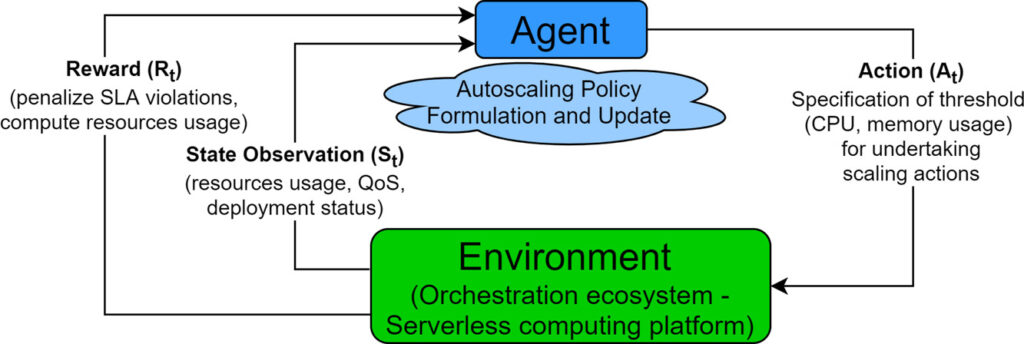
k8s RL autoscaler is an open-source software project that offers autoscaling mechanisms for serverless applications that are powered by Reinforcement Learning (RL) techniques. A set of RL environments and agents have been implemented (based on Q-learning, DynaQ+ and Deep Q-learning algorithms) for driving autoscaling mechanisms, able to autonomously manage dynamic workloads with Quality of Service (QoS) guarantees, while opting for efficient usage of resources. The produced environments and agents are evaluated in real and simulated environments, taking advantage of the Kubeless open-source serverless platform. A simulation environment has been also developed to support extensive training of RL agents to overcome time-related limitations of real environments. The k8s-RL-autoscaler has been extended towards a multi-agent setting for managing autoscaling mechanisms within an application graph, based on the application of Multi-agent Reinforcement Learning (MARL) techniques. The extended version is called as k8s-marl-autoscaler. License: Apache License 2.0 GitLab repository (for single-agent setting): https://gitlab.com/netmode/k8s-rl-autoscaler GitLab repository (for multi-agent setting): https://gitlab.com/netmode/k8s-marl-autoscaler

Intent Lifecycle Management Simulation Kit

The Intent Lifecycle Management Simulation Kit manages the intent lifecycle during the deployment of distributed application graphs over multi-cluster/multi-provider infrastructure. Three control loops are defined supporting actions from the intent translation and validation to the intent provision and management across distributed resources, and the intent assessment, reporting, and feedback. The first control loop supports semantic and syntactic validation of the intent description of an application graph. The second control loop manages the intent during application provision, leading to proactive and reactive reconfigurations. The third control loop manages reporting information and provides recommendations for intent refinement. The Intent Lifecycle Management Simulation Kit is implemented in the framework of the 6GREEN Horizon Europe project.

GitLab repository: https://gitlab.com/netmode/intent-lifecycle-management

SustainGraph

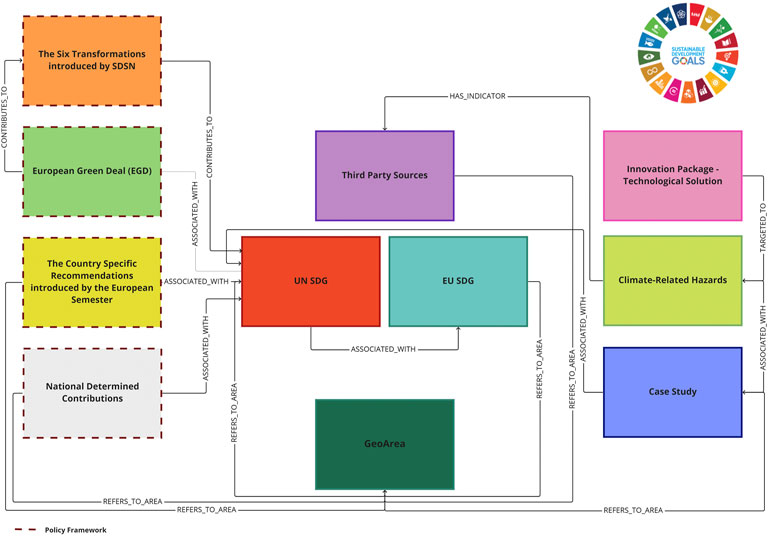
SustainGraph is an open-source Knowledge Graph (KG), developed with Neo4j technology, that considers in a holistic way the tracking of the progress towards the Sustainable Development Goals (SDG). It monitors SDG targets and the evolution of indicators at national and regional levels, along with their relationship with specified policies and the implementation of case studies across Europe. SustainGraph is considered as the basis for the systemic representation of knowledge related to the SDGs, enabling the collection and homogeneous representation of data along with their semantics and overcoming data management barriers (e.g., existence of multiple data silos, absence of semantic alignment of data coming from different disciplines). In addition to tracking the evolution towards the achievement of the targets posed in the SDGs, one of the main objectives of SustainGraph is to enable the development of participatory modeling and analysis processes (e.g., socio-environmental models), taking advantage of the semantic alignment of the represented terms and the knowledge produced through the analysis of the information that is made available. SustainGraph is developed within the framework of the ARSINOE H2020 project.

The data hosted in SustainGraph can be easily explored through a user-friendly web interface available at https://sustaingraph.netmode.ece.ntua.gr.

GitLab repository: https://gitlab.com/netmode/sustaingraph
License: Eclipse Public License 2.0

SDGDetector

SDGDetector is an open-source Python library designed to classify and analyze text data in alignment with the United Nations Sustainable Development Goals (SDGs). It provides a flexible and efficient framework for associating textual content—such as reports, national strategies, or policy documents—with one or more of the 17 SDGs, helping researchers, policymakers, and developers better understand how language reflects global development priorities.

At its core, SDGDetector offers two powerful approaches for SDG classification. It supports both a pretrained fine-tuned model for accurate, context-aware SDG classification, and a keyword-based method that uses curated term lists to associate text with relevant SDGs. These approaches can be used independently or combined for more robust and interpretable results.

SDGDetector is developed within the framework of the ARSINOE H2020 project. The SDGDetector python library consists of three classes:

  1. SDG_classifier_using_model: This class uses a fine-tuned pre-trained XLNet or RoBERTa model as a classifier, in order to find the probabilities of the given texts with the SDGs. Our fine-tuned pretrained XLNet and RoBERTa models can be found here. The training/testing f1-score of the models is 0.90.
  2. SDG_classifier_using_keywords_extraction: This class finds the most representative keywords of the given texts and computes the similarity scores between them and the keywords of the SDGs. As keywords of the SDGs, we use the keywords based on the methodology explained here and we add as keywords for the SDG17 the keywords which can be found here.
  3. SDG_classifier: This class combines the above classes and computes the association of the given texts using a combinatory index more effectively. This index is defined based on the formula:

Formula of the combinatory index used by SDG_classifier

This library is available on PyPI.

GitLab repository: https://gitlab.com/netmode/sdg-detector
License: CC BY-NC 4.0

CyVer

CyVer is an open-source Python library designed to validate Cypher queries against a given Knowledge Graph schema in Neo4j. It ensures that queries are not only syntactically correct but also semantically valid with respect to the underlying graph structure, including labels, relationships, and property access. This is particularly essential when Cypher queries are generated by LLMs, where hallucinations or schema mismatches are common. CyVer helps catch and correct such issues early, making it a critical component in systems that rely on AI-generated queries. Whether you’re building intelligent graph interfaces or deploying LLM-driven data access tools, CyVer adds a vital layer of reliability and safety. CyVer is developed within the framework of the ARSINOE H2020 project.

The core classes of the CyVer library are:

  1. SyntaxValidator: This class validates Cypher queries for correct syntax and detects conflicting labels in nodes and relationships.
  2. SchemaValidator: This class ensures that Cypher queries conform to the structural constraints and patterns defined in the provided knowledge graph database schema. It validates whether the nodes, relationships, and paths referenced in a query align with the expected schema structure, helping to maintain consistency and prevent errors.
  3. PropertiesValidator: This class ensures that Cypher queries access only valid properties for nodes and relationships based on their labels or types.

This library is available on PyPI.

GitLab repository: https://gitlab.com/netmode/CyVer
License: CC BY-SA 4.0

EmoSociograms

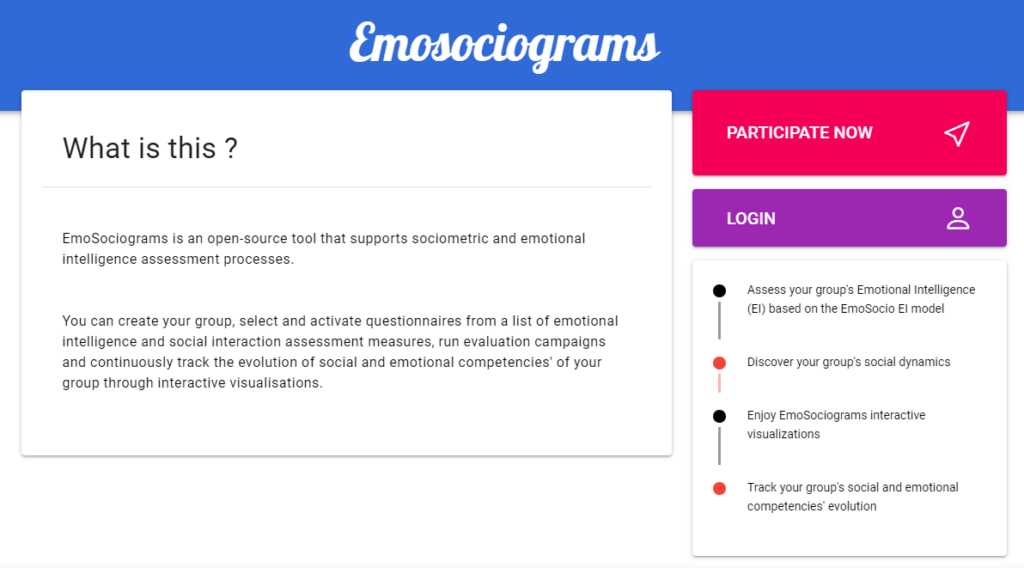
EmoSociograms is an open-source tool that supports sociometric and emotional intelligence assessment processes based on the EmoSocio open-access Emotional Intelligence (EI) model. You can create your group, select and activate questionnaires from a list of emotional intelligence and social interaction assessment measures, run evaluation campaigns and continuously track the evolution of social and emotional competencies’ of your group through interactive visualisations. EmoSociograms is currently under application and evaluation in groups of students in primary and secondary schools within the framework of the EduCardia Erasmus+ project.

License: GNU GPLv3

Link: https://emosociograms.com/
GitLab repository: https://gitlab.com/netmode/emosociograms

EduCardia SEL Activities Repository

The EduCardia Social and Emotional Learning (SEL) Activities Repository hosts a set of activities that can be applied to schools to promote the development of social and emotional competencies of students. The activities are targeted to various age groups of students in both primary and secondary education level. Classification of the SEL activities is provided, based on the core social and emotional competencies that they are targeted to and in accordance with the EmoSocio Emotional Intelligence (EI) model. Through the repository, the teachers may easily navigate to the pool of activities, select the ones that fit better the needs of the students in their classroom and apply them.

The EduCardia SEL Activities Repository is available here: https://sel-activities.netmode.ece.ntua.gr

SeLCont

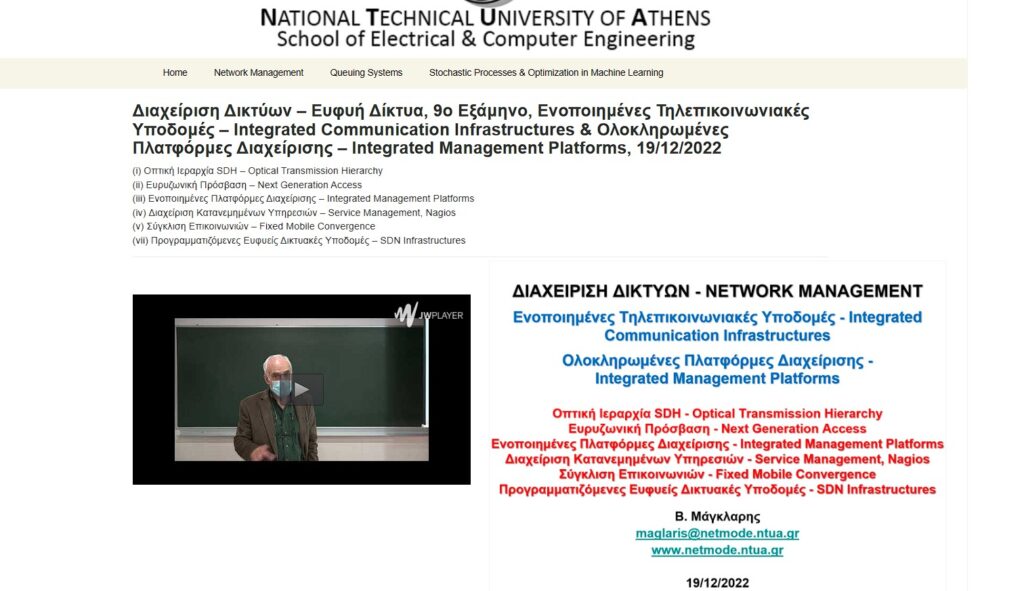
SeLCont (Synchronized eLearning Content) was developed at the Network Management & Optimal Design (NETMODE) laboratory of the National Technical University of Athens (NTUA). It is an easy to use toolkit with minimal post-processing effort and no special installation requirements from lecture rooms. The final outcome is dynamically adjusted to any user browser (laptop, desktop, tablet, smart phone) running Windows, Android and iOS. It centers on WordPress CMS, with adjustable HTML5 Web pages of lecture material (ppt’s with or without annotations, PDF’s, Internet screens etc.), synchronized with video-audio, stored in YouTube (or any video provider) and reproduced via the popular JWPlayer.

License: GNU GPLv3

GitHub repository: https://github.com/netmode/selcont

Skip to content